Back in the studio

June 29th, 2008

studio-shot.jpg

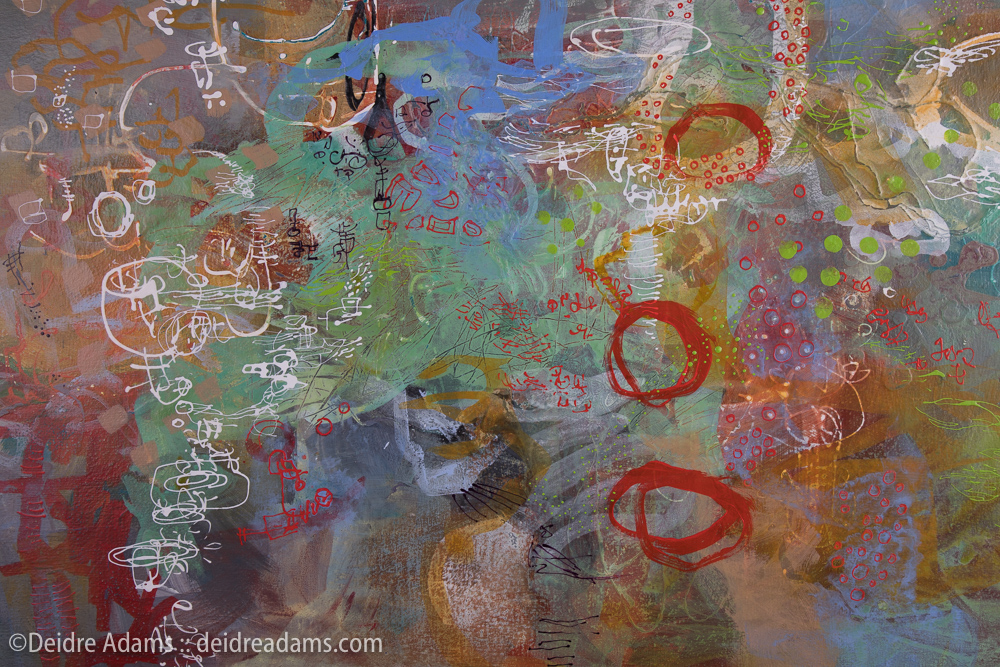
Untitled, ©2008 Deidre Adams

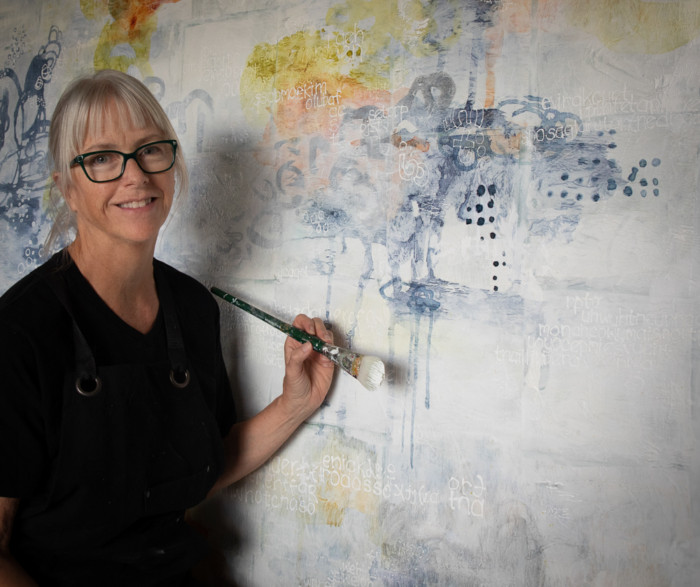
After a bit of a hiatus, I’m so happy to finally get some time to go back into the studio, as of yesterday. This is a shot of a piece I started a long time ago but haven’t had time to work on. Yesterday I finally sat down and finished the quilting, about a full 8 hours’ worth or more. I don’t do the entire 8 hours in one sitting; that would be a bit excessive. The time is broken up by meals, trips downstairs to do laundry or let the can in/out, and once, to see the latest present she brought us (more about that later).

This is how a piece looks after quilting but before blocking, full of lumps and bumps and wonderful (at least to me) texture. The next step is to throw it in the washer to equalize the stitching, then I’ll pin it up to the design wall to dry and thus flatten it out. I almost wish I could leave it bumpy, but I haven’t become that independent in my art making just yet. I still worry too much about what others think.

I know I’m not the only artist who is conflicted by the dilemma of how best to balance the drive to make art and the drive to avoid being broke. This is partly why I haven’t written a post in a while. I’ve been in a sort of paralyzed, deer-in-the-headlights state trying to figure out what I should do with my life. This is how the inner conversation goes:

Self 1: “You’re an artist. What are you doing wasting time at this job doing stuff that doesn’t really have anything to do with who you are in life when you could be in the studio developing your work? Who knows how many good years you’ve got left?”

Self 2: “That’s just crazy talk. How can you even think of quitting when the future is so uncertain? The economy is tanking — what if you end up homeless? Even in the best of circumstances, you’ll have no money to travel or do anything fun. Besides, it’s really a fantastic job — the people are great to work with, the pay is good, and you have security.”

Self 1: “Well ya know, you’re not getting any younger. If you don’t do something soon, before you know it, you’ll just end up being a tired old lady sitting in a cube, staring at a computer screen, wondering where your life went.”

Self 2: “But we have a 15-year-old who’s going to college in 2 years. It’s become glaringly apparent that he’s not likely to be getting a full-ride scholarship anywhere, so how will we pay for that if you’re unemployed?”

And so on and so forth, round and round. But this past week, Self 1 finally won out. I finally got the courage to tell my supervisor I’m leaving. As soon as the words were out of my mouth, I regretted it. Besides giving up a great job, my supervisor is one of my best friends, and I’ll miss talking with her on an almost-daily basis. But the future is wide open now, so it’s sink or swim!

The self-portrait: Part II

May 30th, 2008

adams-sp.jpg

Self-portrait, 36 x 36, ©2007 Deidre Adams

As mentioned in an earlier post, the self-portrait is a very common assignment for art school studio classes. This is one that I did in Painting II last fall. The direction called for making a “psychological” self-portrait. Despite my tendency to agonize over these things and want to read in more than is really there, I do think this came out pretty good and so I use it as a kind of signature image here on the blog and in other places when needed.

If you’re not super-comfortable with your appearance, it can be rather disconcerting to have to stare at your own face for long periods of time. It does help to do it from a photo rather than a mirror, because after awhile it just becomes shapes and values that you are trying to reproduce in a painting, and you can stop obsessing about the strangeness of it. I was working from a printed version of the image below, which I created by montaging a photo I took with a self-timer together with a photo of the side of a train car & a pencil drawing of a quilting pattern from my sketchbook.

adams-self-portrait3.jpg

You can see that I didn’t get the eyes & eyebrows quite right, but I was very absorbed in thinking about the colors and having fun with the brushwork, and I was not too concerned with making a perfect copy.

adams-sp-p1.jpg

This self-portrait shows a big improvement over the one I did in Painting I, which I’m only showing here (left) very tiny because it is so Lame (yes, with a capital “L”).


Now for the next thing …

May 18th, 2008

adams-detour.jpg

Detour, 39 x 39 inches, ©2008 Deidre Adams

Detour is one of my pieces to be included in 12 Voices, a SAQA-sponsored exhibition which will open at the Dennos Museum Center in Traverse City, Michigan, on Sept. 3, and travel for a year afterward. I feel quite honored to be included in this show. Jurying was done by portfolio, and there were 128 entries from around the world. Juror Penny McMorris said, “12 Voices is a welcome departure from the usual survey shows which sample trends. It offers a rare, in-depth look at twelve of the best quilt artists working today.”

I’ve never been very good at the horn-tooting thing, but I’m pretty excited about this show. I’m in some very good company, with fellow artists Teresa Barkley, Elizabeth Busch, Linda Colsh, Judith Content, Angela Moll, Clare Plug, Joan Schulze, Merle Axelrad Serlin, Susan Shie, Ginny Smith, and Kathy Weaver.

School is finally over for the semester, yay! But I still have lots to do before I can fully get my focus back into the studio — I have a couple of big design projects that I need to finish up. But just between you and me, I did sneak a couple of artmaking hours in last Wednesday, the first day after finals. I just had to, for my sanity. That Understanding Visual Language exam was painful!

Does technology improve our lives?

May 4th, 2008

adamsfreeyourself.jpg

©2008 Deidre Adams

This semester, I have two classes with very similar names: Visual Thinking and Understanding Visual Language. It took me a little while to get the names straight, but the basic difference is that the first is a hands-on class, kind of a survey of different software programs combined with a sprinkling of design principles, and the second is about theory and kind of an introduction to some of the higher-level critical stuff that we’ll be getting into down the road.

Since my day-job is graphic designer, it seems like I would have been able to test out of taking this Visual Thinking class, but I’d heard horror stories about how hard they make it to do that, and the class had already started, so I decided to just stick with it — how hard could it be? Turns out it was really pretty fun and had some good assignments. The last one before the final was to do a “social issues” poster. I was rather stuck in trying to come up with an idea, vaguely thinking maybe global warming or something political, but then the answer came up in the Understanding Visual Language class.

‘We were talking about the Cyborg Manifesto, which describes a cybernetic organism — a hybrid of machine and organism — and how this might apply to, say, a person with a cellphone or an iPod with headphones. I’ve really been struck for a while now by how many people walk around constantly talking or texting on their cell phones. This includes two people very close to me (no need to name them, they know who they are!). It also involves the syndrome known as “CPA,” or “constant partial attention,” in which I will be having a conversation with a certain person, when all of a sudden he stops dead, takes the Blackberry out of its belt holster, and proceeds to read the e-mail that just caused him to receive a vibe. Is it just me, or is this crazy? Personally, I don’t see how being a slave to this thing makes anyone’s life any better. Call me a Luddite, but I dream of the days before we all had to be constantly available by cell phone, and when you could have a nice conversation in a restaurant because there weren’t TV screens in every possible direction you could look.

Of course, I have my own issues. I can rarely go more than a couple of hours without reading my e-mail, for instance. I have no idea what gem of wonderfulness I might miss if I don’t get on for an entire day, but I sure as heck don’t want to take the chance.

Eva Hesse - Contingent

April 27th, 2008

hesse-contingent.jpg

Contingent, Eva Hesse, 1969

This piece has been the focus of my attention for the last several weeks. I just finished writing a research paper on it for my Understanding Visual Culture class. Eva Hesse created this work during the last year of her life, mostly through the assistance of other people, because of her illness due to a brain tumor. She died when she was just 34 years old.

The panels in this work are made from fiberglass and latex over a kind of heavy-duty cheesecloth. Hesse was a kind of pioneer in her working methods, and she turned to working with these materials after creating a solid body of work from more “crafty” stuff like wound cord and papier maché. She worked extensively with the latex even though she knew it would become unstable over time. Unfortunately, most of these works have deteriorated beyond the point where they can be exhibited, so getting to see any of them in person is unlikely.

The assignment for this paper was to choose a work and write about it from a critical and theoretical perspective. We all had to do a proposal before starting the paper itself, and the comments I received back from the instructor for mine indicated that I was going down the wrong path. She told me I was using a standard art history approach and suggested I work from a feminist perspective instead. Well, I was reluctant to do that because I’ve never thought of myself as a feminist and don’t really know that much about it. I know that in spite of how much things have changed in the nearly 40 years since this work was made, there is still a great deal of inequity between men and women as far as status, representation, and earnings. In the late 1960s, though, “making it” as an artist was astronomically more difficult for a woman, whose accepted roles of wife, mother, sex object, etc. were just beginning to be challenged by the feminist movement.

One thing that Hesse did have on her side was her location. She was raised and went to school in New York, giving her access to people and galleries that gave her career a huge advantage. It also shaped her perspectives on what women could accomplish with the proper determination. I doubt whether she would have achieved the same success in the visual arts if she had grown up in small-town middle America at that time.

There was a lot of discussion on the SAQA Yahoo group recently about women and fiber arts, and how neither have achieved the success they deserve. I have mixed feelings about this. On the one hand, I do think yes, it would be great if textile and fiber arts could have the same status that painting and sculpture have in the fine art world. On the other hand, I can’t help thinking that whatever success I’ve had so far in my art career has been due to the fact that it is somewhat of a niche market. The playing field is definitely smaller, and it seems the ratio of shows to artists in our medium is greater than it is for art in general. I wonder if I would have any recognition at all if I were doing more traditional paintings? Probably not.

I do think we have an uphill battle as far as educating the public at large as well as those in the art world about our medium. But it’s going to take more than just making a lot of noise about what we deserve.

Starting to flail a bit …

April 14th, 2008

adams-between_the_lines.jpg

Between the Lines, 60 x 26 inches (each of two), © 2007

I’m getting down to the wire in the semester; only 4 more weeks to go. But that does mean the due dates are stacking up quickly. I have to come up with a design for a “social issues” poster by tomorrow, as well as finish writing an 8-page paper which examines a work of art from a “theoretical/critical” perspective (as opposed to historical), and get more footage and editing done for my next video rough cut, all within the next couple of days.

My blogging time will be severely limited for a while. But I know my habits, and I know if I let this go for too long, it will be really easy to just blow it off altogether – kind of the way I’ve been known to let other things (exercise, filing, etc.) go in the past. The only way to discipline myself is to keep up the momentum and not backslide.

So, what I’ll do is just put up some brief posts about past work, because obviously I’m not making much new right at the moment. The above piece was finished and installed at the Louisville Library last October. It’s a diptych, but the two halves were installed on either side of a big window in one of the library’s study rooms. This piece was something that really did push me forward into deciding to start a blog, because when it was done, I wanted to publicize it, but I don’t have a quick and easy way to incorporate new things into my web site at the moment. The blog is also great because you can give some background info, instead of being limited to just a caption.

One other side note – the watermark with my name was done with Adobe Lightroom, a new toy I purchased a while back but haven’t had time to delve into very deeply just yet. What I’ve been using it for so far is to get all my images cataloged so I can find things easily. It has a super-easy export feature, which is where the watermark comes in. Now I need to figure out if I can make it a bit smaller – this looks a little more aggressive than I would like.

ArtQuilt Elements & Breaking New Ground

April 7th, 2008

adams_shadesofwhite.jpg

Shades of White, 48 x 48 inches, ©2007 Deidre C. Adams

This past weekend I’ve been at the joint SAQA/SDA conference, Breaking New Ground, which was held in conjunction with the opening of ArtQuilt Elements in Wayne, Pennsylvania, a suburb of Philadelphia. This was a great opportunity for me to meet a lot of people whom I’ve been talking to via e-mail for some time – so nice to be able to put faces together with names.

Shades of White, above, was juried into the ArtQuilt Elements show. This was the first time I’ve ever gotten into this show after several years of trying, and I thought the quality of the work in this year’s exhibit was outstanding – so I’m very pleased to have been included. The conference events included a tour of some of the area’s current fiber art exhibits and happenings, including a stop at the Snyderman/Works Gallery, where the 6th International Fiber Biennial is on view through April 23. This is an amazing show; there’s so much here that it was impossible to take it all in within the short amount of time we had there. Some of my favorites were the pieces by Dorothy Caldwell (see some of her work here and here) and Matthew Harris, whose work I’d seen in Surface Design Magazine, but can’t seem to find much about him on the web.

We also stopped at the Gross McCleaf Gallery to see some amazing work by Emily Richardson and Judith James. Emily’s fabric constructions are very much like paintings, as they are made from painted and pieced fabrics with a wide range of opacity which results in a rich layered effect with an intriguing contrast of pastel and very strong colors. She was there in the gallery answering questions, and I enjoyed talking with her about her process. Judith had been one of the keynote speakers at the conference the day before, so I had seen slides of her work during her talk. What really struck me was their size – for some reason, while watching the slide presentation, I had gotten the idea that they were very large, so I was surprised at their quite modest scale when seen in person at the gallery. They are still wonderful, though – perhaps even more so, for the attention to the tiniest detail and the imaginative way she uses the muted and understated colors of the discharge process in her compositions.

I’m also taking one of the workshops offered as part of the symposium. I thought as long as I was going as far as Philadelphia, I needed it to be longer than a 2-day trip to make it worth the travel. So I’m taking Leslie Nobler Farber’s “Digital Approaches” workshop to try some new techniques in printing images onto various substrates. More on that later – I’m getting very tired of computers. Unfortunately, the timing of this event fell into a very busy time at school. One of my classes this semester is “Video Art I,” and my first “rough cut” is due on Thursday. So I already have my laptop with me since I needed it for the digital printing workshop, but I also had to lug a 500mb external disk drive along so I can work on my video project in my hotel room in the evenings. Some fun!

Maybe I really am crazy …

April 6th, 2008

adams-glove.jpg

Work glove ©2008 Deidre C. Adams

Closely related to the one-shoe phenomenon is the one-glove phenomenon. This particular specimen was located at a new-home construction site near my dad’s house in Albuquerque, where I had been visiting him a couple of weeks ago. In all the time I was growing up in that neighborhood and for many years afterward, there was nothing but sand and hills and tumblewoods for as far as you could see across the street from his house. Now they’re finally starting to put up a development there.

So while on that visit, my husband and my dad and I went for a walk to see what was going on over there in the mesa. I brought along my pocket camera because you never know what great things you might find. Other great finds on that walk were this:

adams-bird.jpg

Dead bird ©2008 Deidre C. Adams

And this:

adams-marlboro.jpg

Marlboro Country ©2008 Deidre C. Adams

It was while waiting for me to take the third one that it finally dawned on my dad that there was a pattern going on here. He turned to my husband and in a voice he must have thought was quiet enough for me not to hear, he said “What is she doing? She’s just taking pictures of junk!” Would he ever have thought to ask me about anything that ever motivated me in life? Nah… We finished our walk without the subject coming up again.

The one-shoe-in-the-road phenomenon

March 27th, 2008

adams-shoe2.jpg

Shoe near Pueblo, Colorado. © 2006 Deidre Adams

Why are there so many single shoes out there in the universe? This is a question that has always plagued me. I’m not the only one who thinks about this, as evidenced by the great discussion of the question at The Straight Dope.

I wish I had a photo of every single shoe I’ve seen lying by the side of the road, sadly forlorn and bereft of its mate. Unfortunately, the single shoe rarely appears when I’m prepared with camera in hand, as it did for this extreme example in the photo above. But still, every time I see one, I have a burning desire to know how that shoe got there. This one must have been here in this exact spot, less than 500 feet from the road on Interstate 25 just north of Pueblo, Colorado, for many years, completely undisturbed. What’s the story?

Well, I think I’ve found the answer, in this video by Spike Jonze.

Jeannette DeNicolis Meyer

March 19th, 2008

meyer_winter-diary-triptych.jpg

Winter Diary, 37 x 80 inches, ©2006 Jeannette DeNicolis Meyer

This piece is one of my favorite works by Jeannette DeNicolis Meyer. It feels like a landscape but isn’t, necessarily. Its quiet beauty and luscious blues evoke a restful peace, yet the rhythm and movement of the circles and color blocks give a sense of movement and energy that keep the eye moving throughout the work. The exquisite red-orange stripe is just the right dash of spice, the icing on the cake. I can’t stop looking at it!

Last September, I had the pleasure of hearing Jeannette speak at a meeting of the Front Range Contemporary Quilters. She is an outstanding speaker, full of warmth and inspiration while at the same time being very organized and focused. Her words and manner are meditative and thoughtful, indicating a sense of purpose to everything she does. Jeannette says:

“ Once I clear the room of critics and exhaust all avenues of procrastination and finally begin, I love how the slow process of working layer by layer involves a rhythm of cerebration and handwork. … I love those moments, when all, or maybe most, is revealed, the design decisions click into place and life is good.”

You probably can’t see it in this tiny photo, but Jeannette uses a combination of hand and machine quilting for a unique result and an interesting contrast of textures. This was one of the things she talked about in her presentation, of using the quilting in a mindful way to enhance and integrate with the rest of the piece, instead of just putting it on randomly as an afterthought.

speakingcloth.jpgWinter Diary is featured in the book Speaking in Cloth: 6 Quilters, 6 Voices, by Jeannette and her co-author, Ann Johnston. I highly recommend this book for the beautiful work along with the wonderfully inspirational narrative by each of the 6 artists.

It is available directly from Jeannette on the Books page of her web site.

Next »